IT Risk Management
CCK Strategies helps organizations identify, evaluate, and manage technology risk so leadership can make informed decisions with confidence.
Technology risk doesn’t just live in the IT department. It affects operations, compliance, financial reporting, insurance, and stakeholder trust. Most mid-market businesses know they have risk but lack a structured way to measure it, prioritize it, and manage it over time. From our offices in Tulsa and Frisco, CCK works with organizations across Oklahoma, Texas, and nationwide to build IT risk management programs that connect technology risk to business impact. As a CPA and advisory firm, we bring a perspective most IT providers don’t: we understand how technology risk intersects with financial risk, regulatory compliance, and governance at the leadership level.
IT Risk Management Services
FRAMEWORK
What IT Risk Management Is
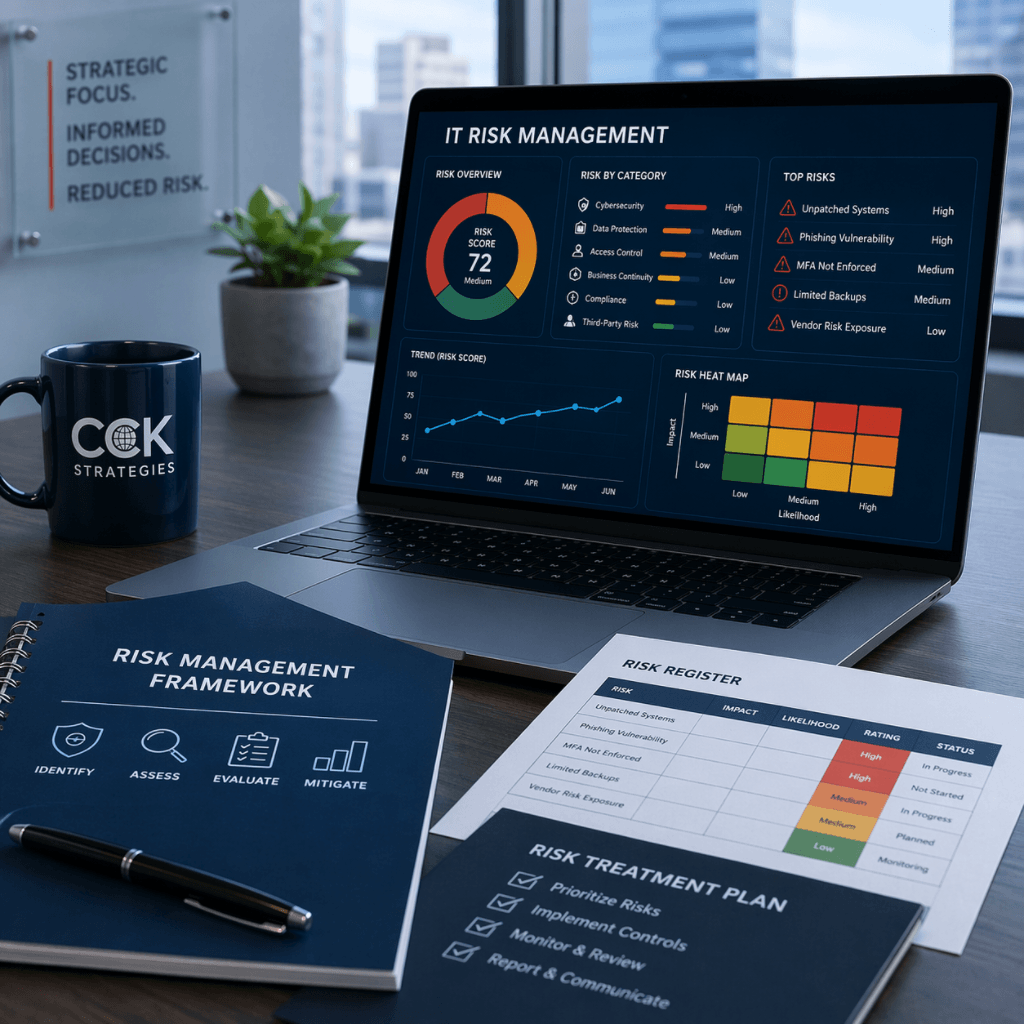
IT risk management is the ongoing process of identifying, assessing, prioritizing, and managing risks related to an organization’s technology environment.
Technology risk extends beyond cybersecurity. It includes risks related to system availability, business continuity, regulatory compliance, vendor relationships, data protection, operational resilience, and the organization’s ability to support business objectives through technology.
A mature risk management program does not eliminate risk entirely. Instead, it provides leadership with visibility into where risks exist, how they may impact the organization, and what actions should be prioritized to reduce exposure.
CCK helps organizations move from reactive problem solving to a structured, risk-based approach that supports stronger decision-making, governance, compliance readiness, and long-term organizational resilience.
EVALUATION
What CCK Evaluates
Our IT risk assessments are grounded in established frameworks including NIST Cybersecurity Framework (CSF), CIS Critical Security Controls, ISO 27001, and other recognized risk management standards.
We evaluate your environment across key domains including access controls, data protection, network security, endpoint management, backup and recovery capabilities, incident response readiness, business continuity planning, cloud security, governance practices, and third-party vendor relationships.
Our assessment also considers employee security awareness, technology governance, compliance obligations, cyber insurance requirements, and alignment with frameworks such as SOC 2, HIPAA, PCI DSS, and state-level privacy regulations.
The result is a comprehensive understanding of your organization’s technology risks, current control effectiveness, and opportunities for improvement.
FIT
Who Needs IT Risk Management
IT risk management is essential for organizations that rely on technology to support operations, protect sensitive information, maintain compliance, and serve customers effectively.
It is particularly valuable for organizations preparing for compliance audits, renewing cyber insurance coverage, responding to client security questionnaires, managing third-party risk, or strengthening cybersecurity governance.
Organizations often engage CCK when they have experienced rapid growth, implemented significant technology changes, entered highly regulated industries, completed acquisitions, or simply reached a point where technology risks need to be managed more formally.
If leadership lacks visibility into technology risk or struggles to prioritize remediation efforts, a structured IT risk management program provides the clarity needed to make informed decisions and allocate resources effectively.
DIFFERENTIATOR
Why Choose CCK
Many IT risk assessments are performed by managed service providers, security vendors, or consultants that also sell remediation services. CCK is different.
As a CPA and advisory firm, we have no products to sell and no vendor relationships that influence our recommendations. Our focus is helping leadership understand and manage risk in a way that supports business objectives, operational resiliency, compliance requirements, and long-term growth.
We connect technology risk to business risk by translating technical findings into practical insights that leadership, boards, and stakeholders can understand and act on. Rather than producing a technical report that sits on a shelf, we provide actionable guidance that supports strategic decision-making and effective risk management.
From our offices in Tulsa and Frisco, CCK serves as a trusted advisor to organizations across Oklahoma, Texas, and nationwide.
Frequently Asked Questions
What is the difference between an IT risk assessment and a cybersecurity assessment?
A cybersecurity assessment focuses specifically on evaluating your security posture, including controls, vulnerabilities, threat readiness, and the effectiveness of cybersecurity safeguards.
An IT risk assessment takes a broader view. It evaluates risk across the entire technology environment, including cybersecurity, business continuity, operational resilience, vendor management, regulatory compliance, governance practices, and technology dependencies.
Many organizations begin with a cybersecurity assessment to understand their security posture and then expand into an ongoing IT risk management program that provides a more comprehensive view of technology-related business risk.
What frameworks does CCK use for IT risk management?
Our risk management approach is grounded in recognized frameworks and industry standards including NIST Cybersecurity Framework (CSF), CIS Critical Security Controls, ISO 27001, SOC 2, HIPAA, PCI DSS, and applicable regulatory requirements.
We tailor each assessment to the organization’s industry, regulatory environment, risk profile, and business objectives rather than applying a one-size-fits-all methodology.
The goal is to provide leadership with a practical framework for understanding, managing, and monitoring technology risk over time.
How long does an IT risk assessment take?
Most IT risk assessments are completed within three to five weeks depending on the size and complexity of the organization, number of locations, technology footprint, regulatory requirements, and scope of the review.
The process generally includes discovery discussions, information gathering, control evaluation, risk scoring, analysis of findings, and presentation of recommendations.
Our focus is not simply identifying risks but helping leadership understand their potential business impact and develop a practical plan for addressing them.
Does CCK provide ongoing risk management support?
Yes. IT risk management is most effective when treated as an ongoing governance and leadership function rather than a one-time assessment.
After completing an assessment, CCK can continue supporting organizations through vCISO services, technology roadmap development, compliance readiness initiatives, vendor risk oversight, periodic risk reviews, and cybersecurity governance activities.
Our goal is to help organizations continuously monitor, prioritize, and manage technology risk as business objectives, regulatory requirements, and threat landscapes evolve.
How does IT risk management connect to compliance?
Most compliance frameworks require organizations to demonstrate that they have a formal process for identifying, assessing, and managing technology-related risks.
Frameworks such as SOC 2, HIPAA, PCI DSS, NIST, and ISO 27001 all incorporate risk management principles as a foundational component of compliance programs.
A structured IT risk management program helps organizations prioritize remediation efforts, support audit readiness, satisfy regulatory expectations, strengthen cyber insurance applications, and respond more effectively to client security questionnaires.
By connecting compliance efforts to risk management, organizations can focus resources on the areas that present the greatest potential impact to the business.