Incident Response, Disaster Recovery & Business Continuity Planning
Preparation today determines how your organization responds tomorrow.
Cyberattacks, ransomware events, system failures, natural disasters, vendor outages, and operational disruptions can affect any organization. Yet many businesses lack documented plans, clearly defined responsibilities, and tested recovery procedures to guide decision-making during a crisis.
CCK helps organizations develop incident response, disaster recovery, and business continuity programs designed to reduce downtime, protect critical operations, support regulatory requirements, and strengthen organizational resilience.
From our offices in Tulsa and Frisco, we work with organizations across Oklahoma, Texas, and nationwide to build practical response and recovery strategies that help leadership navigate disruption with confidence.
Incident Response, Disaster Recovery & Business Continuity Planning
RESILIENCE
What We Help Build
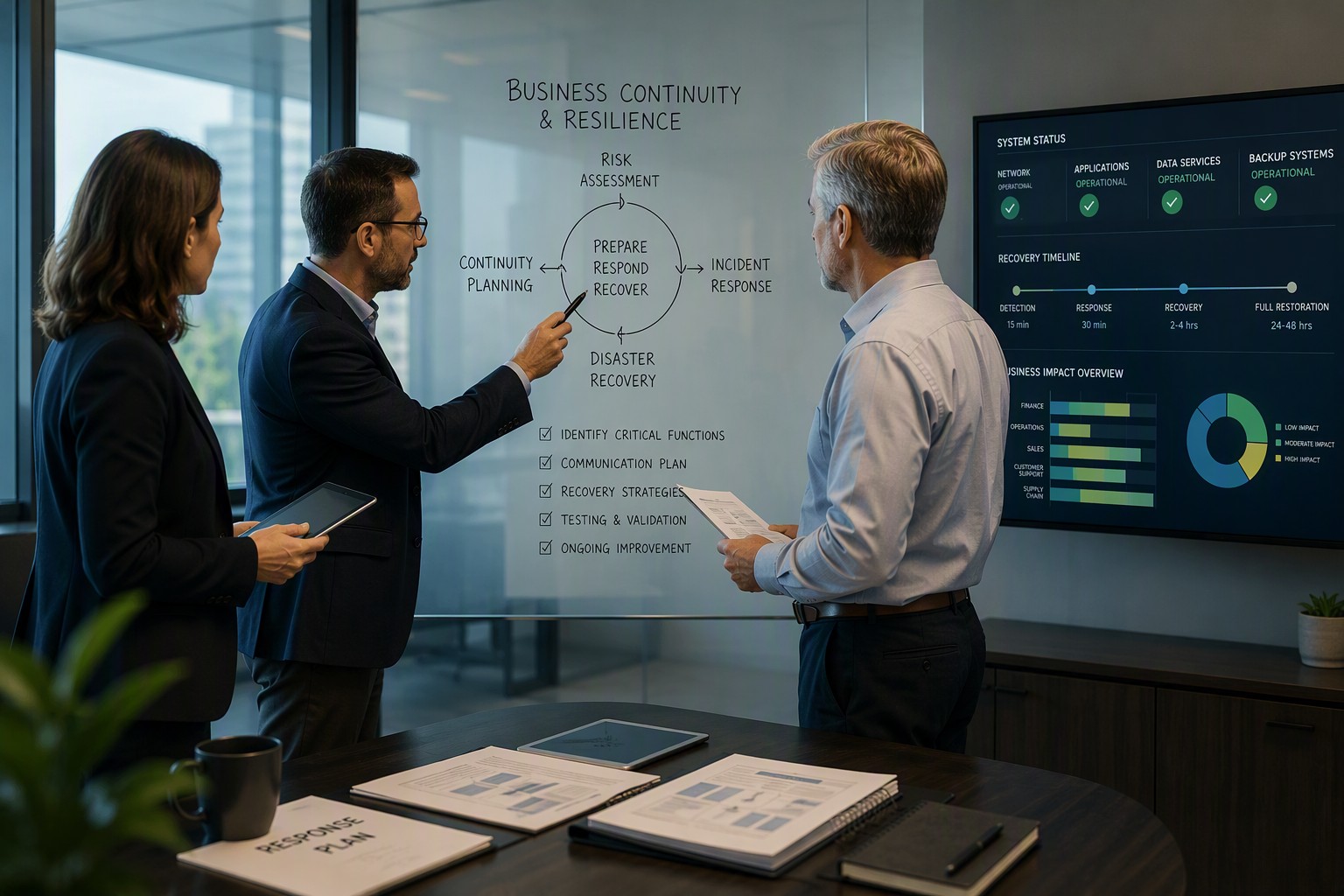
A resilient organization understands how to respond to incidents, recover critical systems, maintain essential operations, and communicate effectively during disruptions.
CCK helps organizations develop practical incident response plans, disaster recovery strategies, business continuity procedures, communication protocols, recovery priorities, and governance processes that support coordinated response efforts.
Our objective is not simply to create documentation. We help leadership establish a framework that supports decision-making, minimizes downtime, protects business operations, and improves organizational resilience.
The result is a more prepared organization with clear plans for responding to unexpected events and recovering critical functions when disruptions occur.
FIT
Who Needs Planning
Organizations that rely on technology, support critical operations, store sensitive information, maintain compliance obligations, or depend on third-party service providers should have formal incident response, disaster recovery, and business continuity plans.
Planning is especially important for organizations with distributed workforces, cloud-based systems, regulatory requirements, cybersecurity concerns, cyber insurance obligations, or operations that cannot tolerate extended downtime.
Organizations frequently engage CCK after significant growth, technology modernization efforts, security incidents, compliance initiatives, or as part of broader risk management and governance programs.
If your organization would struggle to answer “What happens if our systems go down tomorrow?” this engagement provides the structure needed to prepare effectively.
PROCESS
Building the Plan
Our engagement begins with business impact analysis, risk identification, recovery requirement assessments, and discussions with key stakeholders responsible for critical business functions.
We evaluate operational dependencies, technology systems, recovery capabilities, communication processes, vendor relationships, and organizational readiness to identify potential gaps and areas of risk.
Based on those findings, we develop documented procedures covering incident response, disaster recovery, business continuity planning, communication protocols, recovery priorities, testing methodologies, and ongoing program maintenance.
The result is a practical and organized framework that leadership can use to prepare for, respond to, and recover from disruptive events.
DIFFERENTIATOR
Practical Planning That Works
Many organizations have response and recovery plans that were created solely to satisfy audit requirements and have never been reviewed, tested, or used in practice.
CCK focuses on building practical plans that leadership and employees can understand, maintain, test, and execute when real-world disruptions occur. Our approach emphasizes usability, operational alignment, and continuous improvement rather than simply producing documentation.
As a CPA and advisory firm, we understand how operational disruptions affect financial performance, compliance requirements, stakeholder confidence, and business continuity. We translate those risks into actionable planning that supports long-term resilience.
The goal is to help organizations build confidence that they can continue operating through disruption while protecting employees, customers, and critical business functions.
Frequently Asked Questions
What is the difference between Incident Response and Disaster Recovery?
Incident response focuses on identifying, managing, containing, and recovering from disruptive events such as cyberattacks, data breaches, ransomware incidents, or other security-related events.
Disaster recovery focuses on restoring technology systems, infrastructure, applications, and data after a disruption has occurred. It addresses how quickly systems can be recovered and returned to normal operation.
Both disciplines work together as part of a broader resilience strategy. Incident response manages the event itself, while disaster recovery focuses on restoring the technology environment after the event has been controlled.
What is Business Continuity Planning?
Business continuity planning focuses on maintaining critical business operations during and after a disruptive event.
Rather than concentrating solely on technology recovery, business continuity planning addresses how employees, processes, facilities, communication procedures, vendors, and operational functions will continue operating when disruptions occur.
The goal is to minimize business impact, maintain essential services, and ensure the organization can continue serving customers, employees, and stakeholders during challenging situations.
How often should plans be reviewed?
Incident response, disaster recovery, and business continuity plans should be reviewed at least annually and whenever significant changes occur within the organization.
Examples include technology upgrades, cloud migrations, mergers and acquisitions, leadership changes, regulatory updates, major process changes, or third-party vendor transitions.
Regular reviews help ensure plans remain accurate, responsibilities remain clearly defined, and recovery objectives continue aligning with organizational needs and business priorities.
Can CCK help test our plans?
Yes. Testing is one of the most important components of an effective resilience program.
CCK can facilitate tabletop exercises, incident response simulations, recovery testing activities, and scenario-based planning exercises designed to evaluate readiness and identify potential gaps before an actual disruption occurs.
Testing helps leadership validate assumptions, improve coordination, strengthen response capabilities, and build confidence that plans will function effectively during real-world events.
Is this only for cybersecurity incidents?
No. While cybersecurity threats are a major concern, incident response, disaster recovery, and business continuity planning address a wide range of potential disruptions.
Examples include ransomware attacks, system outages, cloud service interruptions, vendor failures, natural disasters, power outages, supply chain disruptions, facility issues, and other operational events that could impact business operations.
A comprehensive resilience program helps organizations prepare for both technology-related and non-technology disruptions that could affect critical business functions.